
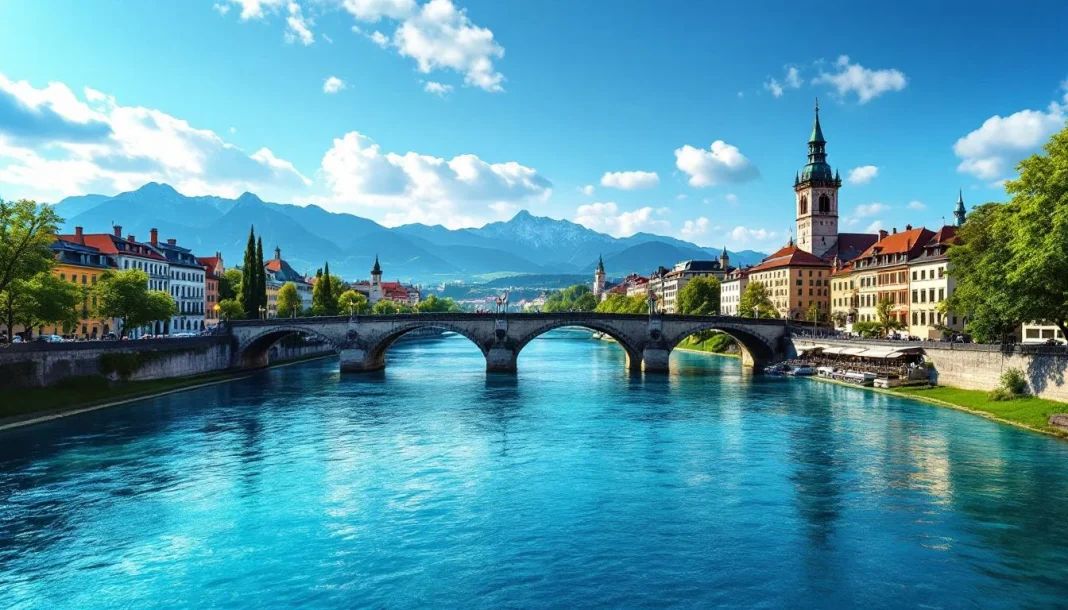
When talking about German beer, people often immediately think of Munich. But few know that before the legendary breweries, even before Reinheitsgebot, there was water. Water flowed down from the Alps through layers of limestone and glacial gravel, carrying a unique mineral profile—soft, balanced, and seemingly made for brewing lager.
Munich is more than just the beer capital of Bavaria. It's where water becomes a heritage. While Burton-on-Trent has sulfate-hard water, Pilsen has super-soft water, Munich sits in the middle—soft enough to honor malt, mineral-rich enough to provide depth. It is this balance that has given birth to the amber lager that the world calls "Munich style.".
Geographical and historical region
Munich is situated on the Bavarian plateau, about 100 km north of the Alps. The Isar River flows through the city, but the water used for brewing beer doesn't come from this river. It comes from deeper layers—from aquifers formed over thousands of years as glaciers melted.
During the Pleistocene epoch, glaciers from the Alps left behind dense layers of gravel and sand. Rainwater and melted snow seeped through these layers, were naturally filtered, and absorbed a moderate amount of minerals. The result was groundwater with a low to medium hardness—much softer than London or Dublin, but not as ultra-soft as Pilsen.
The history of brewing in Munich dates back to the 13th century, when Benedictine monasteries established the first breweries. Weihenstephan, located about 35 km from Munich, is recognized as the world's oldest continuously operating brewery. But it was Munich itself that perfected the lager brewing technique.
In 1516, Duke Wilhelm IV issued the Reinheitsgebot in Ingolstadt, Bavaria. This law stipulated that beer could only be produced from water, malt, and hops. Yeast was not mentioned because microorganisms were not yet understood at that time. But the important thing was: water came first. The Bavarians knew their water was special.
The 19th century saw Munich become a center of brewing science. Gabriel Sedlmayr II at Spaten Brewery pioneered the application of thermometers and refrigeration techniques. He was also the first to understand that Munich water was perfectly suited for Munich malt—a type of malt dried at higher temperatures, giving it an amber color and toasted flavor.
It's no coincidence that Munich lager is so different from Pilsner. Pilsner has water that is almost mineral-free, highlighting the Saaz hops and creating a sharp bitterness. Munich has soft water but still has enough carbonate to buffer the pH, allowing the malt to shine without becoming overly acidic.
Mineral profile
Munich water is soft to moderately soft, with a total hardness of approximately 100-150 ppm (parts per million). Compared to Burton-on-Trent, which can reach up to 1200 ppm, Munich falls on the milder end of the spectrum.
The calcium content in Munich water ranges from 75-80 mg/L. This level is sufficient to support enzyme activity during saccharification and help yeast flocculate well after fermentation. However, it is not high enough to create a distinct "mineral" taste as in hard water regions.
Magnesium levels are low, around 15-20 mg/L. This is the ideal amount—enough to support yeast health without causing an unpleasant bitterness. Too much magnesium can create a metallic taste, which Munich beer avoids entirely.
Sulfate is an interesting point. Munich lagers only have about 10-20 mg/L of sulfate, very low compared to Burton's 600-800 mg/L. This means the hops in Munich lager aren't as "dry" and "sharp" as in English pale ale. Instead, the bitterness blends smoothly with the malt.
Chloride levels are at 2-5 mg/L, almost negligible. Chloride typically enhances the perception of fullness and sweetness in beer. This low level keeps Munich lager light and airy, even malt-forward.
Bicarbonate (or alkalinity) is the key to Munich water, ranging from 150-200 mg/L. This bicarbonate level buffers the pH of the mash when using dark malts like Munich malt or Vienna malt. If very soft water like Pilsen is used with dark malt, the pH will drop too low, creating a harsh, sour taste. Munich water solves this problem naturally.
Affects the taste of beer.
Munich water creates a neutral yet warm “canvas.” It doesn’t highlight the hops like high-sulfate water, nor does it dull the malt like supersoft water. It allows the malt to tell its story.
Munich malt is dried at a higher temperature than Pilsner malt, creating the Maillard reaction—similar to when you bake bread. The result is a bread-like flavor, crust, and sometimes a slight caramel note. Munich water with moderate bicarbonate maintains the mash's pH in the 5.2-5.4 range, where enzymes work optimally to convert starch into fermentable sugars.
The sweetness of Munich lager doesn't come from sugar. It's malty sweetness—from non-fermentable dextrin and melanoidin compounds from heat reaction. Soft water with low chloride content prevents this sweetness from being overwhelmed by an excessive "full mouthfeel.".
Hops in Munich lager are typically Hallertauer Mittelfrüh or Tettnanger — noble German hop varieties. They carry herbal, floral, and subtly spicy notes. With low sulfate content, the bitterness of the hops is not sharp but rather "rounded." You perceive the hops as a background element, not the main character.
The clarity of Munich lager is also related to the water. Calcium levels of 75-80 mg/L help the lager yeast (Saccharomyces pastorianus) settle well after fermentation. Combined with the lengthy lagering process lasting several weeks, the beer achieves crystal-clear clarity without the need for extensive filtration.
The aftertaste of a Munich lager is its defining characteristic. There's no lingering bitterness like in an IPA, no metallic or sulfurous notes. Just a clean sensation, with a subtle malt aftertaste that fades away. This is the result of mineral-balanced water, a healthy lager yeast, and patient lagering techniques.
Carbonation in Munich lager is typically moderate, around 2.3-2.5 volumes of CO2. Soft water dissolves the CO2 well and keeps the foam smooth and consistent. A proper Munich Dunkel will have a thick, creamy white head, about two fingers thick, clinging to the sides of the glass as you drink.
The beer style was created.
Munich Helles Helles is the most popular representative of this region. Born in 1894 at Spaten Brewery, Helles is Munich's answer to the success of Pilsner Bohemia. But instead of copying, the Munichians created something entirely different. Helles is a lighter yellow than traditional Munich lager, but still retains its malt-forward characteristics. It has a light breaded sweetness, just enough hops to balance it, and an extremely clean finish. Munich's soft water allows Pilsner malt and Munich malt to blend without being overshadowed by minerals.
Munich Dunkel Dunkel is an older style, predating Helles. Dunkel means "dark" in German, and the beer has an amber to dark brown color. This is where Munich water truly shows its strength. The bicarbonate in the water perfectly buffers the pH when using large amounts of Munich malt. The flavor has notes of chocolate, dark bread, and sometimes a hint of dried fruit. Dunkel is a comfort beer—warm, easy to drink, and deep.
Schwarzbier Schwarzbier is sometimes associated with Munich, although its more accurate origin is the Thuringia and Saxony region. However, Munich breweries also produce Schwarzbier using local water. It's a "dark beer" but not a stout—it's still a lager, still light and refreshing. The Munich water helps maintain the appropriate acidity level when using roasted malt.
March Oktoberfest beer is a symbol of Munich every autumn. Traditionally, Märzen is brewed in March (März) and lagering throughout the summer in cool caves before being served at the Oktoberfest festival. It has an amber to copper color, a rich malt flavor with notes of caramel and toast. The alcohol content is slightly higher than Helles (5.5-6.1 TP3T). Munich's water with its moderate bicarbonate content is the foundation for this style.
Bock Variations like Doppelbock and Maibock are also associated with Bavaria. Doppelbock was particularly developed by Paulaner monks as a “liquid bread” during Lent. With an OG (Original Alcohol Content) that can reach 1080 and an extremely rich malt flavor, Doppelbock requires water with sufficient bicarbonate to control the pH when mashing with large amounts of specialty malt.
Bavarian Weissbier (wheat beer) is also brewed with Munich water, although Weihenstephan in Freising is the traditional center. The soft water helps keep Weissbier from becoming too acidic from the wheat malt, while also highlighting the characteristic esters (banana) and phenols (clove) from the Weizen yeast.
Legendary brewery from this region.
Spaten-Franziskaner-Bräu is one of Munich's "Big Six"—six breweries allowed to sell at Oktoberfest. Spaten dates back to 1397 and is where Gabriel Sedlmayr II revolutionized lager techniques in the 19th century. Sedlmayr shared his expertise with Anton Dreher of Vienna and together they shaped the European lager style. Spaten Oktoberfest and Spaten Premium Lager remain the benchmark for Munich-style lager.
Paulaner began as a monastery brewery in 1634, run by Paulaner monks. They were the creators of Salvator—the first Doppelbock—and the origin of the "-ator" suffix in the names of other Doppelbock breweries. Paulaner Helles and Paulaner Weissbier today still embody the Munich character: clean, balanced, malt-forward.
Augustiner-Bräu is the oldest continuously operating brewery in Munich, dating back to 1328. Remarkably, Augustiner still uses wooden casks (Hirschen) to serve beer at Oktoberfest – a rare tradition that still exists. Augustiner Edelstoff, an export-style lager, is one of the most beloved beers among local Munich residents.
Hofbräu München was founded in 1589 by Duke Wilhelm V, initially to serve the Bavarian royal family. Their enormous Hofbräuhaus beer hall in the heart of Munich is a world-renowned tourist destination. Hofbräu Original is a classic Munich Helles — clean, malt-forward, and dangerously easy to drink.
Weihenstephaner in Freising, although located outside Munich, uses the same water source and aquifer system. Recognized as the world's oldest brewery (dating back to 1040), Weihenstephaner remains affiliated with the Technical University of Munich and is a leading center for brewer training. Weihenstephaner Hefeweissbier is often considered a benchmark of style.
Lessons for the modern craft brewer
Munich water profiles can be recreated by starting with RO (reverse osmosis) or distilled water, then adding minerals. The goal is to achieve calcium around 75 ppm, magnesium 15-20 ppm, sulfate 10-20 ppm, chloride below 10 ppm, and bicarbonate 150-200 ppm.
Baking soda (sodium bicarbonate) is the simplest way to increase bicarbonate. However, caution is needed as it also adds sodium, which can create a "salty" taste if used excessively. Calcium carbonate (chalk) is another option, but it dissolves poorly in water. Some brewers use slaked lime (calcium hydroxide) to increase both calcium and alkalinity.
When brewing Munich-style lager, let the water work with the malt, not against it. If your source water has high sulfate content, the beer will lean toward being "hoppy" even if you don't intend it. If the water is too soft and you use too much Munich malt, the pH of the mash may drop too low.
Malt acid or lactic acid can help adjust the pH if the water has too high a bicarbonate content. The target pH for mash is 5.2-5.4. Many modern brewers use a pH meter and adjust it batch by batch, but if you start with the correct Munich water profile, adjustments will be minimal.
Finally, remember that water is only part of the equation. Munich lager also needs quality Munich malt, noble hops, a healthy lager yeast, and patient lagering technique. But without the right water, all the other things will fail to shine properly.
Water is the terroir of beer. Just as the Burgundy soil creates an unreplicable Pinot Noir, Munich's water has shaped a beer style that the world strives to emulate. We can adjust the minerals, but we cannot recreate the centuries of history infused into every drop of water flowing down from the Alps.