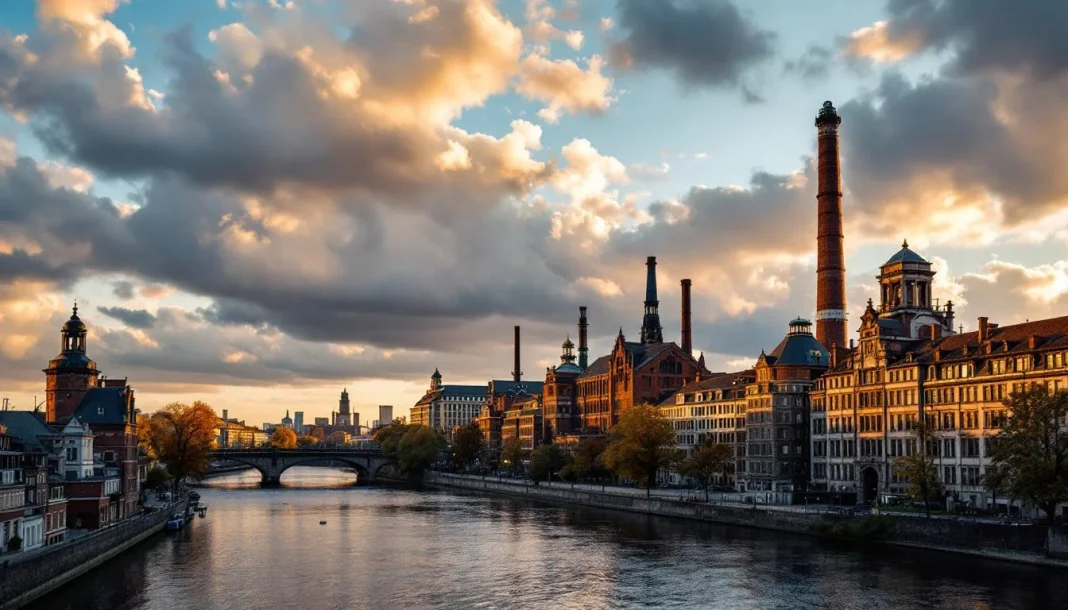
In the heart of the industrial Ruhr region, where factory chimneys once defined the skyline, lies a resource more precious than coal and steel—water. Dortmund Water, with its unique mineral profile, has transformed a working-class city into Europe's beer export capital.
If Burton-on-Trent is the birthplace of Pale Ale, then Dortmund is the mecca of Export Lager. The water here is more than just H₂O—it's the chemical blueprint for a beer style that has conquered the global market for over a century. Let's delve into the story of the water source that shaped an entire industry.
Geographical and historical region
Dortmund is located in the eastern Ruhr region, in the state of North Rhine-Westphalia, western Germany. The city sits in the Ruhr and Emscher river valleys, where layers of Cretaceous limestone and dolomite form a unique underground water reservoir. The geology here is a mixture of carbonate sedimentary rocks and sandstone layers, filtering water over thousands of years to create a remarkably balanced mineral profile.
Dortmund's brewing history dates back to the Middle Ages, when the city was a member of the Hanseatic League—the most powerful trading network in Northern Europe. By the 14th century, Dortmund had over 60 operating breweries. However, the real turning point came in the mid-19th century, when the lager brewing technology from Bavaria spread throughout Europe.
In 1843, Heinrich Wenker—the founder of Dortmunder Kronen—began experimenting with lager techniques. He realized that the local water, with its high hardness but better balance than Burton's, allowed for the creation of a distinct beer: bright like Pilsner Bohemia, but fuller and easier to drink. This was the precursor to the Dortmunder Export style.
The Industrial Revolution transformed Dortmund into one of Europe's largest steel and coal production centers. Hundreds of thousands of workers flocked there, and they needed beer—lots of beer. Abundant water resources, a well-developed railway network, and a massive workforce created the perfect formula for a large-scale brewing industry.
By the early 20th century, Dortmund surpassed Munich to become Germany's largest beer-producing city. In 1927, production peaked at over 1.8 million hectoliters. The term "Export" in the beer's name is no coincidence — this beer was designed for long-distance transport, and Dortmund's water, with its high mineral content, helped stabilize the beer throughout its journey.
Mineral profile
Dortmund water is hard water, but unlike Burton or Munich, it achieves a rare balance of ions. This is what makes it special in the world of brewing.
Calcium levels range from 230-260 ppm—higher than most other renowned beer-producing regions. This high calcium content promotes enzyme activity during saccharification, efficiently converting starch and producing a clear wort. It also supports protein precipitation, resulting in excellent stability for the finished beer.
Magnesium is at a moderate level, around 25-40 ppm, enough to support healthy yeast without causing an unpleasant bitterness. Sulfate is in the range of 120-150 ppm — high enough to highlight the hops, but not so strong as Burton's that the bitterness becomes harsh. This is the key to Dortmund's character: distinctly bitter yet smooth.
Chloride levels are at 100-120 ppm, creating a full-bodied and rounded feel on the palate. The sulfate/chloride ratio is nearly balanced—rare in nature—allowing the beer to have both sharpness and good body. Bicarbonate ranges from 180-250 ppm, much higher than Pilsen but lower than Munich, sufficient to buffer the pH when using light malts but not hindering the saccharification process.
Affects the taste of beer.
Each ion in Dortmund beer acts like an artist in an orchestra, and the symphony they create is Dortmunder Export — the most balanced style in the lager family.
High calcium combined with moderate bicarbonate creates an ideal saccharification environment for Pilsner malt. Alpha-amylase and beta-amylase enzymes work efficiently, converting starch into fermentable sugars at a high rate. The result is a beer with good alcohol content, a medium to full body, and a subtle sweet aftertaste from dextrin.
The balanced sulfate level provides a clean, distinct bitterness that doesn't linger as long as Burton's. Dortmunder Export's bitterness is often described as "firm but not harsh." Hops are used primarily for bitterness rather than aroma, and the sulfate helps this bitterness spread evenly and dissipate quickly.
Chloride levels equivalent to sulfate create a full-bodied and smooth mouthfeel. This is the biggest difference from Pilsner Bohemia — if Pilsner is light and airy like spring water, Dortmunder Export is mellow like a river. The sensation on the tongue is thicker, but still retains the necessary freshness for a beer meant to be drunk in large quantities.
In summary, Dortmund produces a beer with a bright straw-yellow color, absolute clarity, a light breaded malt aroma, a balanced bitterness, and a clean finish. It's a beer designed for heavy drinking—coal and steel miners of yesteryear could drink liters a day without getting tired of it.
Another interesting feature: the high mineral content helps Dortmund beer remain more stable during transport. Calcium aids in oxalate precipitation, reducing the risk of cloudiness. This is why Export could be "exported" over long distances while maintaining its quality—a crucial factor in the era before refrigeration.
The beer style was created.
Dortmunder Export is the greatest legacy this water source has left to the world of beer. This is the style. lagers It sits between the Pilsner and Munich Helles — stronger, fuller, but still retaining its characteristic bright color.
Technically, Export has an alcohol content of 5.0-5.5% ABV, higher than a typical Pilsner. The IBU bitterness is around 23-30, balanced with the malty sweetness. The color ranges from straw yellow to golden yellow, with a crystal-clear appearance. Carbonation is moderate, not as harsh as Pilsner but enough to create a refreshing sensation.
Besides Export, Dortmund's water is also suitable for cooking various styles. Pale Lager Others. Many local breweries used to produce both Märzen and Bock, taking advantage of the high calcium content to process larger quantities of malt. However, Export has always been the star.
In the 20th century, Dortmunder Export spread globally. Breweries in the Netherlands, Belgium, and even Japan began producing beer in this style. In the United States, many German-born brewers brought the Export recipe with them when they emigrated, helping to shape the industry. American Lager after that.
Unfortunately, the Export style almost disappeared in the latter half of the 20th century. Mergers and globalization led to Dortmund breweries gradually falling into the hands of large corporations, who then shifted to producing Pilsner in line with international trends. Today, finding an authentic bottle of Dortmunder Export is not easy.
However, this style is being revived by the movement. craft beer. Many craft breweries around the world began experimenting with Export, seeing it as an exciting technical challenge — creating a perfectly balanced beer, not leaning towards malt or hops, but in absolute harmony.
Legendary brewery from this region.
Dortmunder Union (DUB) is perhaps the most well-known name associated with this region. Founded in 1873 from the merger of several smaller breweries, DUB quickly became one of Europe's largest beer producers. The giant "U" logo on the brewery tower was a landmark of Dortmund throughout the 20th century.
Dortmunder Actien Brauerei (DAB), founded in 1868, was a fierce rival of DUB. The two breweries competed intensely, constantly pushing each other for innovation. DAB was renowned for its heavy investment in brewing research, and its laboratories contributed significantly to the industry's advancements.
Kronen Brauerei, the oldest continuously operating brewery in Dortmund, was founded in 1430. It was here that Heinrich Wenker created the modern Export style in the 1840s. Kronen remained independent until 1996, when it was merged into the Radeberger group.
In addition, there were Thier, Stifts, Hansa, and dozens of other names that made up Dortmund's golden age. Sadly, most have disappeared or are now just ghost brands in the portfolios of large corporations. Today, only a few small factories strive to preserve the heritage, such as Bergmann Brauerei — revived in 2007 with the mission of restoring the traditional Export style.
Lessons for the modern craft brewer
Dortmund Water teaches us the most important lesson in brewing: balance. While Burton boasts about sulfates and Pilsen prides itself on smoothness, Dortmund quietly does what no one else does—harmonizes everything.
For craft brewers wanting to recreate the Dortmund water profile, the goal is to achieve a sulfate/chloride ratio close to 1:1, with a high calcium content of around 230-260 ppm. Start with RO water and add calcium sulfate (gypsum) and calcium chloride in equal proportions. Add a small amount of baking soda to achieve the desired bicarbonate level.
More important than the recipe is the philosophy: Export isn't a beer to impress, but a beer to drink in moderation. In an age where craft beers race for bitterness, alcohol content, and extreme flavors, perhaps we need to look back at Dortmund—the city that once produced the most beer in Germany—by making the most balanced beer.
The water of Dortmund reminds us that terroir in beer isn't just about difference, but about harmony. Sometimes, the perfect water source isn't the most exceptional one—but the one that knows how to keep everything in place, so that no element overwhelms another. As the old Dortmund brewers understood: the best beer is the one that makes you want another.