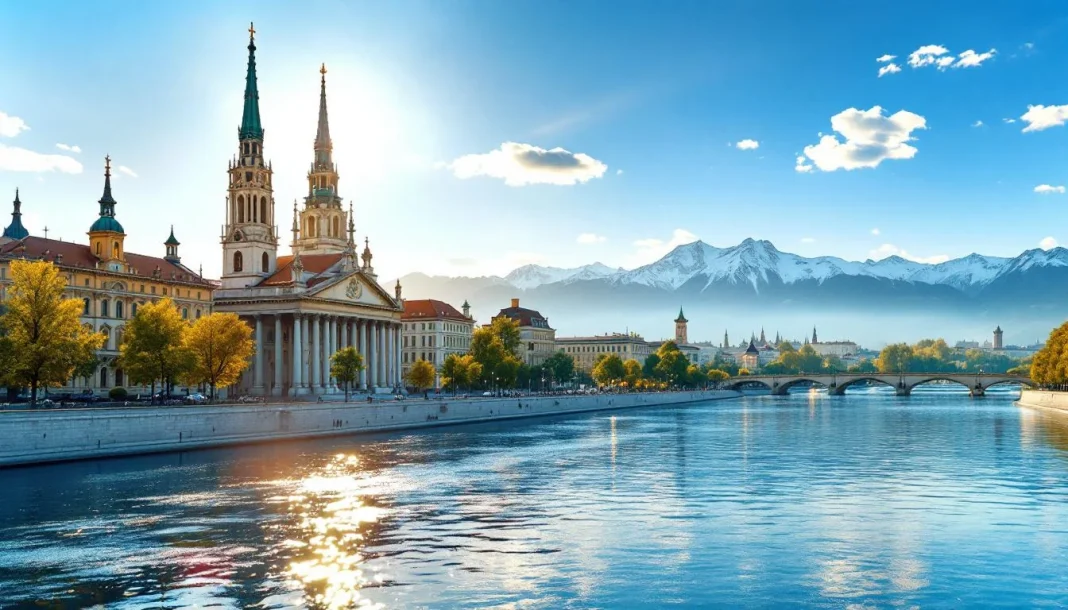
In the heart of Vienna, water flows not just past magnificent fountains or quaint cafés. Here, the water carries the story of the Alps, of millions-of-years-old limestone formations, and of a beer revolution that changed Europe. Vienna Water is proof that terroir in beer is just as important as in wine — and sometimes, a stream of water is enough to give rise to an entire style.
When Anton Dreher tasted his first lager in 1841, he wasn't just experimenting with technique. He was exploring the potential of the very water from his birthplace—water that Viennese people had drunk from for centuries without knowing it would redefine the world of beer.
Geographical and historical region
Vienna is situated in a unique geographical location in Europe. The city lies in the Vienna Basin, where the Alps meet the Danube plain. This confluence creates a unique groundwater system—meltwater from Alpine snow seeps through multiple geological layers before reaching the city.
Since Roman times, Vienna has been renowned for its clean water. The ancient Vindobona people built a system to bring water from mountain springs to the city. This tradition continued through the Middle Ages, when monasteries began brewing beer with local well water.
The turning point came in the 19th century. Emperor Franz Joseph I ordered the construction of the Hochquellenwasserleitung—a high-water pipeline. Completed in 1873, the project brought water from the Rax and Schneeberg mountain ranges, more than 100 km from Vienna, directly into the city. This was not only a feat of engineering but also a commitment to water quality.
But the story of beer begins even earlier. In 1841, Anton Dreher at the Schwechat brewery combined Viennese water with a new type of kiln-dried malt and Bavarian lager yeast. The result was Vienna Lager—the first amber-colored lager in history. Local water played a crucial role: mineral-rich enough to support the malt enzymes, but not so hard as to overpower the delicate malt flavor.
Dreher's success spread throughout Europe. Vienna became one of the three great beer capitals, along with Munich and Pilsen. Each city, each water source, each style is distinct. But Vienna stands as a bridge—between Bavarian stout and Bohemian lager.
The two world wars devastated the Viennese brewing industry. Many breweries closed or were destroyed. Viennese Lager nearly disappeared from its homeland. But the water source remained, flowing down from the Alps, waiting for a new generation of brewers to rediscover it.
Mineral profile
Vienna Water is moderately hard, with a total hardness ranging from 150-250 ppm CaCO₃. This is a rare balance in nature — not too soft like Pilsen, not too hard like Burton.
Calcium in Viennese water is typically at 50-80 ppm, sufficient to support enzymes during mashing and promote healthy yeast activity. Magnesium is present at a modest level of 15-25 ppm, just enough to supplement yeast nutrition without causing a metallic bitterness.
Vienna Water's defining characteristic lies in its nearly balanced sulfate and chloride ratio. Sulfate levels are 30-60 ppm, significantly lower than Burton but enough to subtly highlight the hops. Chloride ranges from 20-40 ppm, contributing to the roundness and malty sweetness. This ratio—approximately 1.5:1 sulfate/chloride—is key to the balanced flavor of Vienna Lager.
Bicarbonate is the most complex element, typically at 150-200 ppm. With water from Alpine vite rocks, bicarbonate levels are higher than in softer waters. This explains why Vienna Lager uses kiln-dried malt: the amber color of the malt helps acidify the mash naturally, neutralizing bicarbonate and achieving the optimal pH for enzyme activity.
Affects the taste of beer.
Viennese water creates a flavor profile that we might call "deeply balanced." No minerality overwhelms the other; everything harmonizes like a Viennese symphony.
With moderate calcium levels, alpha-amylase and beta-amylase enzymes function effectively. As a result, the wort has good fermentability while retaining its body from dextrin. The finished beer has a distinct malty sweetness without being heavy or cloying. This is the signature of Vienna Lager — a toasted malt flavor, a light caramel, but a clean and drinkable finish.
The balanced sulfate-chloride ratio allows both malt and hops to express themselves. In traditional Vienna Lager, noble hops like Saaz or Styrian Goldings are used with modest IBU levels. Water doesn't bring out the bitterness like Burton, nor does it mask it like Pilsen. Hops play a supporting role, but they are not forgotten.
High bicarbonate levels affect perceived acidity. Viennese beer typically has a smoother, less sharp taste compared to Pilsner. This characteristic aligns with continental European tastes—who prefer a more rounded profile rather than the crispness of Bohemian beer.
Viennese-style kiln-dried malt—with Maillard reactions creating an amber color—is not just an aesthetic choice. It's a chemical solution. The melanoidins in the malt are slightly acidic, helping to lower the mash's pH to the optimal 5.2-5.4 range without complex water treatment. Our ancestors didn't know what pH was, but they knew which malts suited their water.
The end result is a beer with malt-derived complexity, moderate bitterness, and a medium mouthfeel. Vienna Water doesn't make extreme beers. It makes beers to drink in moderation, to savor during long afternoons at the pub.
The beer style was created.
Vienna Lager is the true offspring of this tradition. The style, born in 1841, boasts a distinctive amber color, a malt-toasted-biscuit flavor, and a moderate alcohol content of 4.7-5.5% ABV. While Munich produces the dark Dunkel and Pilsen the golden Pilsner, Vienna stands in the middle—both literally and figuratively.
Vienna Lager almost disappeared from Austria after the war, but it found a new home in Mexico. Austro-German immigrants brought the recipe with them, and today brands like Negra Modelo and Dos Equis Amber are descendants of this style. Mexico is different from Vienna, but the spirit remains.
Märzen, the traditional autumn beer style, is also deeply influenced by the waters of Vienna. While Munich is often associated with Oktoberfest Märzen, the Vienna version of this style is lighter, amberer, and easier to drink. Before refrigeration became common, Märzen was brewed in March and stored in cold cellars throughout the summer — the balanced mineral content of Vienna's water helps the beer retain its freshness.
Modern Festbier—the lighter golden style served at Oktoberfest today—can also be brewed well with the Viennese water profile. The balanced sulfate-chloride levels are suitable for a beer with a strong malt presence but still crisp and refreshing.
Amber Lager, a style of American craft beer, is directly influenced by Vienna. When craft brewers seek to create lagers with richer flavors than American Light Lager, they look to Vienna. Many Amber Lager recipes require adjusting the water profile to be similar to Vienna Water.
For those interested in traditional lager, Vienna Water opens the door to... Vienna Lager and styles March — the quintessential representatives of continental European beer.
Legendary brewery from this region.
Schwechat Brewery is the birthplace of Vienna Lager. Founded in 1632, the brewery became legendary under Anton Dreher from 1836. Dreher traveled throughout Europe, learning techniques from Munich and England, before returning to combine them with his homeland. Today, Schwechat is owned by Heineken, but its legacy lives on in every Vienna Lager brewed around the world.
Ottakringer is the last remaining large brewery in downtown Vienna. Since 1837, the brewery in the 16th arrondissement has used local well water. While its main products today are Helles and Pilsner, following market trends, Ottakringer occasionally releases limited-edition Vienna Lagers — as a tribute to the water that has nourished it.
Stiegl from Salzburg, though not located in Vienna, also uses similar Alpine water. Austria's oldest independently operated brewery (dating back to 1492) has brewed many traditional lager styles, a testament to the power of Alpine water.
Modern craft breweries like Bierol and Brew Age are reviving the Viennese style in its birthplace. They use city water—still from the historic Hochquellenwasserleitung system—to brew batches of Viennese Lager using classic recipes, sometimes with a modern twist.
Lessons for the modern craft brewer
Vienna Water teaches us a lesson about balance. It's not always necessary to have water as soft as Pilsen or as hard as Burton. Sometimes, finding the middle ground opens up the most possibilities.
For craft brewers aiming to recreate the Vienna profile, the goal is: calcium 50-80 ppm, sulfate 30-60 ppm, chloride 20-40 ppm, and controlled bicarbonate. If the source water already has high bicarbonate levels, don't try to remove it completely—instead, use Munich or Vienna malt for natural acidification. This is how the ancients worked with their water.
A sulfate:chloride ratio of around 1.5:1 allows the malt to shine without losing its hop character. This is a good starting point for amber lagers, Märzen, and styles that prioritize malt balance.
More importantly, Vienna Water reminds us that the brewing recipe is inseparable from the environment in which it originates. Anton Dreher didn't "invent" Vienna malt or Vienna Lager by chance. He observed his water, understood its limitations and potential, and then created within that framework.
Water is the main ingredient in over 90% of finished beer. It's not just a neutral solvent, but a terroir—local identity, regional imprint. Just as Burgundy wine is inseparable from the Côte d'Or soil, Vienna Lager is forever linked to the Alpine waters flowing through Vienna. And every time we raise a glass of amber beer, perhaps we should take a moment to think of those distant mountains—where melting snow turns into water, seeping through million-year-old limestone, to finally become the flavor in the glass.