
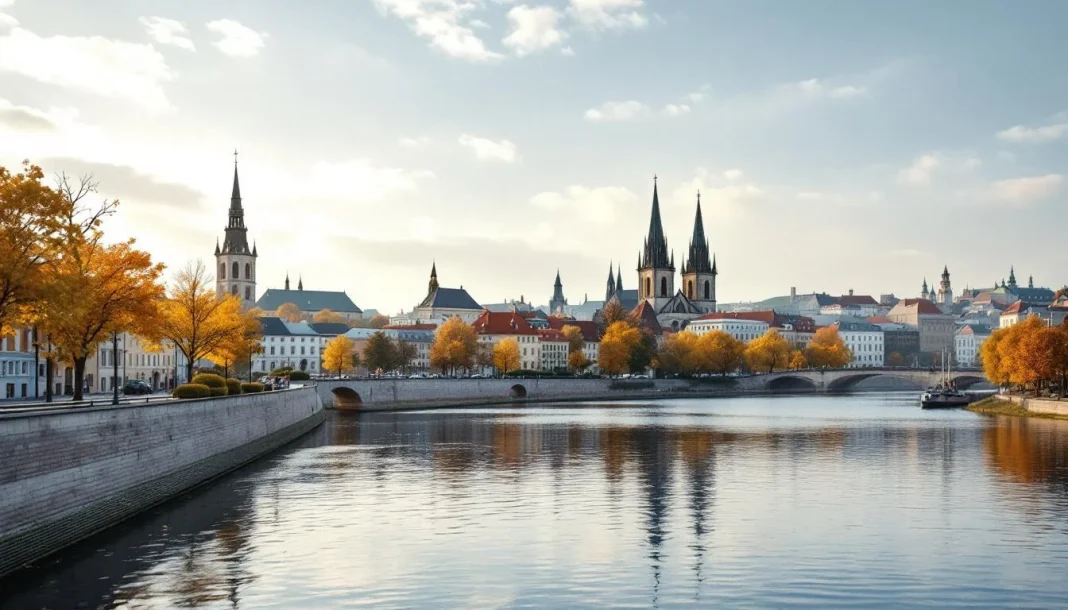
In the world of beer, some water sources become legendary not for their grandeur, but for their near-empty purity. Plzeň water belongs to that category. It is the softest of the famous beer-producing regions—so soft that 19th-century scientists once doubted whether it could be used to brew good beer.
History has proven otherwise. It was this very "mineral deficiency" that allowed malt and hops to speak for themselves in a way never before seen. In 1842, from this very water source, a golden, crystal-clear beer was born — and the world of beer was never the same again.
Geographical and historical region
Plzeň is located in Western Bohemia, where four rivers meet: Mže, Radbuza, Úhlava, and Úslava. The city sits atop a plateau of granite and gneiss—two types of crystalline rock hundreds of millions of years old. This bedrock acts as a giant natural filter, retaining most of the minerals as rainwater seeps through.
Plzeň's groundwater is extracted from an aquifer located 8-12 meters below ground. Unlike other famous beer regions such as Burton-on-Trent or Munich, where water flows over mineral-rich limestone or dolomite, Plzeň's water retains almost the pristine purity of rainwater.
Before 1842, Plzeň was not a beer capital. In fact, the local beer was notorious for being… bad. Bohemian nobles complained so much about the quality that 36 barrels of beer were publicly dumped in front of the town hall in 1838. This event prompted the city to establish the Citizens' Brewery (Měšťanský pivovar) and invite Josef Groll—a Bavarian brewer—to reform it.
Groll brings together three things: Bavarian cold fermentation techniques, lightly toasted golden Moravian malt, and fragrant Saaz hops. But when combined with Plzeň water, the magic happens. The soft water doesn't create the harsh bitterness of hard water regions. Instead, the bitterness from the Saaz hops becomes subtle and rounded. The malt shines with a sweet, breaded flavor. The beer is so clear you can read a newspaper through the glass.
On October 5, 1842, Pilsner Urquell was born — “Original Pilsner.” This name later became the common name for an entire style of beer: Pilsner, or Pils. From a city that brewed poor beer, Plzeň became a mecca that breweries from Germany to America, from Japan to Vietnam, tried to emulate.
Mineral profile
Plzeň water boasts an astonishingly low mineral profile. Calcium ranges only between 7-10 mg/L — ten times lower than Burton and even lower than Munich. This level of calcium is sufficient to support enzymes in the saccharification process, but not enough to affect the flavor. Magnesium is almost absent, at only about 2-3 mg/L.
Sulfate is the component that gives "Burton snatch"—the sharp bitterness in India Pale Ale. In Plzeň, sulfate levels are only 5-10 mg/L. This explains why the bitterness in Bohemian Pilsner is soft and alluring rather than harsh. Chloride levels are similarly low, around 5-8 mg/L—not enough to create the full-bodied or artificially sweet sensation found in some other waters.
Bicarbonate—the enemy of light-colored beers—is only 15-25 mg/L. Compared to Munich (150+ mg/L) or Dublin (300+ mg/L), this is almost zero. High bicarbonate levels force brewers to use dark-roasted malts to balance the pH. Plzeň's low bicarbonate allows the use of light-colored pilsner malts while still achieving the ideal pH during saccharification.
The total dissolved solids (TDS) of Plzeň water are typically below 50 mg/L. For comparison, tap water in many cities has TDS levels of 200-500 mg/L. Plzeň water is truly a “blank canvas”—a blank canvas for malt and hops to paint their picture.
Affects the taste of beer.
The soft water of Plzeň affects beer in subtle ways that not everyone immediately recognizes. First and foremost: it allows the Saaz hops to express their most elegant nature. Saaz is a "noble" hop variety with delicate herbal and floral notes. In hard water, these notes are masked by minerality. In Plzeň water, they bloom like flowers in the morning dew.
The bitterness of Bohemian Pilsner is distinctly different from that of German Pilsner or American Lager. At the same IBU level, beer brewed with Plzeň water feels softer, rounder, and lingers longer. Scientists call this "perceived bitterness," as opposed to "measured bitterness." Soft water significantly reduces perceived bitterness.
The Plzeň domestic pilsner malt reveals flavors of toasted bread, light honey, and sometimes a hint of biscuit. There are no masking mineral notes. No sulfates dry out the palate. The result is an "easy-drinking" beer that is not bland—deep but not heavy.
Beer color is also influenced by the water. Low bicarbonate means a low pH during brewing, and a low pH limits the Maillard reaction—the reaction that creates the brown color. Bohemian Pilsner therefore has its characteristic bright straw-yellow color, not orange or brown like lagers from harder waters.
The clarity of the beer is also aided by soft water. Less calcium means less oxalate precipitation—one of the causes of cloudiness. Traditional Pilsner Urquell is so famously clear that it's called "liquid gold.".
The beer style was created.
Bohemian Pilsner—or Czech Premium Pale Lager according to the BJCP classification—is the brainchild of Plzeň. This style laid the foundation for a host of variations: the slightly drier German Pilsner, the much lighter American Lager, and the globally popular International Pale Lager. It's no exaggeration to say that Plzeň indirectly shaped the beer-drinking tastes of the entire world.
Czech Pale Lager (Světlé Výčepní Pivo) — a lighter version of Pilsner — also originates from this region. With an alcohol content of only 3-4%, it's the "session" beer that Bohemians drink daily. The soft water allows for a light beer that still retains flavor, without being diluted or empty.
Czech Amber Lager and Czech Dark Lager—two siblings of Pilsner—prove that Plzeň water isn't just for pale beers. When caramel malt or roasted malt is added, the soft water still allows these notes to shine through without distortion. Czech Dark Lager Plzeň has a coffee-milk flavor with a hint of chocolate — quite different from German Schwarzbier or Irish Stout.
Modern brewers are also experimenting with brewing Pale Ales and IPAs using Plzeň water profiles. The result is a beer with a strong hop aroma but surprisingly soft bitterness. Some call this a “soft IPA”—a trend that is gaining popularity in the American and European craft beer scene.
Bohemian Pilsner The original source remains the benchmark for evaluating all golden lagers in the world. And that benchmark begins with water.
Legendary brewery from this region.
Pilsner Urquell (Plzeňský Prazdroj) is a name that cannot be overlooked. Founded in 1842, it is the brewery that "gave birth" to Pilsner. To this day, Pilsner Urquell still uses the original Plzeň groundwater and maintains its fermentation cellars in oak barrels — one of the few breweries still doing so. Every year, millions of tourists visit its kilometers-long underground beer cellars.
Gambrinus—a "sister" brewery to Pilsner Urquell—is also located in Plzeň and shares the same water source. Gambrinus focuses on the more mainstream beer segment, but the quality of their water remains a source of pride. The name Gambrinus is taken from the legendary king of beer in European folklore.
Purkmistr—a smaller brewery with a hotel and beer spa—represents the craft beer wave in Plzeň. They experiment with more styles but still respect the local softwater heritage. Some of their offerings include wheat beer and fruit beer, demonstrating the versatility of Plzeň's water.
Not just in Plzeň, breweries worldwide are trying to "replicate" this water profile. From Sapporo in Japan to Budweiser in the US, they treat the water to achieve comparable softness. But as the Czechs say: "You can copy the recipe, but you can't copy the terroir."“
Lessons for the modern craft brewer
The first lesson from Plzeň: soft water doesn't mean "weak" water. On the contrary, soft water is a blank canvas for other ingredients to speak for themselves. If you want to showcase a premium hop or exceptional malt, consider reducing the mineral content of the water.
Lesson two: Don't add minerals just because "it should be added." Many homebrewers habitually add gypsum or calcium chloride by default. Plzeň water proves that sometimes less is more. Taste the water before deciding.
Lesson three: understand the interaction between water and bitterness. If you want a soft, Bohemian-style bitterness, reduce sulfate to below 50 mg/L. If you want a sharp, West Coast IPA-style bitterness, increase sulfate to 150-300 mg/L. Water is a tool for adjusting perception, not just a solvent.
Ultimately, the water of Plzeň reminds us that the terroir in beer is real. A unique water source can shape an entire beer style that has lasted for nearly two centuries and spread across the globe. When you open a bottle of Pilsner—whether in Hanoi or Helsinki—you are drinking the heritage of four rivers and the granite bedrock of Bohemia. Water is not just water. Water is the memory of the land.